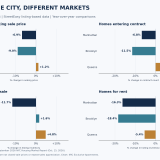
You are paying substantial rent, trying to build savings, and wondering whether purchasing an apartment would put your money to better use. Then a headline arrives: **buying costs 184% more than renting in NYC.**
*Prepared for · NYC Exclusive Apartments*
Does that settle the decision?
It establishes a serious affordability challenge. Your decision still requires a comparison of the homes you would actually consider, the financing available to you, and how long you expect to stay.
The useful question is whether ownership’s benefits justify its costs and risks in your circumstances. Here is how to move from the headline to that answer.
What “buying costs 184% more than renting in NYC” measures
In its October 27, 2026 release, Realtor.com reported these third-quarter figures:
| Measure | Reported amount |
|—|—:|
| Median asking rent | $3,785 per month |
| Estimated monthly ownership cost | $10,737 |
| Monthly difference | $6,952 |
Dividing $6,952 by $3,785 produces approximately **184% more**. Ownership’s estimated monthly outlay was about **2.84 times** the rental figure.
The ownership model used a **$1,409,792 median listing price**, a **10% down payment**, and a **30-year fixed mortgage at the quarter’s average rate of 6.68%**, plus estimated association fees, taxes, and homeowners insurance. This is a historical model, rather than a mortgage quote for November 2.
The rental figure averages three monthly asking-rent medians. It describes advertised listings, rather than every existing lease. The release also flags Staten Island rental data as under review. [Oct 27, 2026]
Separate medians do not describe equivalent homes
A median identifies the middle of a dataset. Two medians do not establish that the homes in those datasets have equivalent size, location, condition, or amenities.
A sale pool containing larger apartments and houses can produce a very different midpoint from a rental pool containing smaller apartments. Neither midpoint tells you what purchasing your current rental—or a close substitute—would cost.
**Hypothetical example:** someone renting a one-bedroom in Queens may be considering a nearby resale co-op. Comparing that rental with a citywide purchase benchmark could obscure the actual choice. Comparing it with a larger Manhattan condominium changes the housing being purchased as well as the ownership arrangement.
Begin with alternatives you would genuinely accept. Match neighborhood, usable space, condition, transit needs, building services, and accessibility requirements as closely as possible. Record meaningful differences rather than pretending every apartment is interchangeable.
A citywide statistic can orient your search. It cannot select your home.
Your down payment changes the monthly bill—and your available cash
A larger down payment reduces the amount borrowed. It also commits more of your savings to the property.
Consider a **hypothetical $1 million purchase** financed with a fully amortizing, 30-year fixed loan:
| Down payment | Loan amount | Monthly principal and interest at 6% | At 7% |
|—|—:|—:|—:|
| 10%: $100,000 | $900,000 | $5,396 | $5,988 |
| 20%: $200,000 | $800,000 | $4,796 | $5,322 |
*Illustrative calculations, rounded to the nearest dollar. These are assumed rates, not current offers. Payments exclude taxes, insurance, mortgage insurance, building charges, repairs, and closing costs. Financing availability and building requirements must be confirmed.*
At 7%, the additional $100,000 down reduces principal and interest by approximately $665 monthly. That improvement comes with $100,000 less available for emergencies, other investments, or near-term plans.
The [Consumer Financial Protection Bureau] recommends reserving money for closing costs, moving, other savings goals, and an emergency cushion before deciding how much to put down. [Consumer Financial Protection Bureau]
Treat the down payment as capital committed to ownership. It is neither a monthly expense nor cash you can readily withdraw. Ask the lender and managing agent about financing limits and any required reserves after closing.
Use the rate you can obtain without depending on refinancing
The illustration also shows why price alone cannot establish affordability. On an $800,000 loan, moving from 6% to 7% increases principal and interest by approximately $526 monthly.
Request written financing estimates based on your credit, down payment, property, and loan structure. Compare rates alongside points, lender fees, mortgage insurance where applicable, and cash required at closing. A lower advertised rate may require additional upfront payment.
The CFPB’s [Loan Estimate explainer](https://www.consumerfinance.gov/owning-a-home/loan-estimate/) distinguishes principal and interest from the total payment and identifies charges you may need to pay separately. [Consumer Financial Protection Bureau]
Build your budget around terms you can secure. Future refinancing depends on future rates, qualification, property eligibility, and transaction costs. A possible refinance should improve an affordable purchase rather than rescue an unaffordable one.
NYC building costs belong in the comparison
Your loan payment is only one part of owning an apartment.
For a condominium, obtain the actual common charges, property taxes, insurance estimate, and any assessments. For a co-op, examine maintenance and its components alongside your apartment loan payment.
The [New York Attorney General] explains that co-op purchasers buy corporate shares associated with an apartment and pay maintenance charges. Have your attorney review what those charges cover so your budget captures every obligation without counting the same expense twice. [New York Attorney General]
Ask about planned capital work and building finances. The Attorney General’s [buyer guidance] emphasizes examining physical conditions and consulting an attorney before signing a purchase agreement. [New York Attorney General]
A fixed mortgage payment does not freeze the entire ownership budget. Building charges, insurance, taxes, and repair needs can change.
Syd’s Field Note
**Practical recommendation:** compare each apartment using its documented monthly obligations and its building’s likely capital needs. An appealing asking price deserves closer scrutiny when substantial work or assessments could follow. The building’s financial condition is part of what you are buying.
Closing costs and your holding period can change the result
Buying involves upfront expenses beyond the down payment. Depending on the transaction, these can include legal and lender fees, appraisal costs, title-related charges, applicable taxes, and building fees.
For example, [New York State] generally imposes a 1% mansion tax on qualifying residential purchases of $1 million or more, with additional NYC supplemental tax beginning at $2 million. Obtain a transaction-specific estimate from your attorney. [tax.ny.gov]
Property type matters too. NYC’s [Department of Finance mortgage recording tax report] identifies individual co-op apartment loans as outside that tax’s liability. Do not apply one blanket closing-cost percentage to every co-op and condo. [nyc.gov]
Selling later can introduce brokerage compensation under your agreement, legal fees, applicable transfer taxes, and building charges. Request an estimate of both buying and eventual selling costs.
**Hypothetical illustration:** assume combined purchase and eventual sale transaction expenses of $60,000. Spread over three years, that is about $1,667 monthly; over ten years, about $500 monthly. This simply allocates an assumed expense over time. It excludes financing effects, opportunity cost, appreciation, and other ownership costs.
A longer holding period spreads transaction costs across more years. It does not guarantee a favorable financial result. Test an earlier-than-planned sale and a flat or declining resale value, too.
Compare cash flow and wealth separately
Every dollar of a mortgage payment affects your bank balance, but principal and interest play different roles. Principal repayment reduces debt and contributes to equity; interest is a borrowing expense. Equity also changes with the property’s value and must be considered alongside selling costs.
For a useful comparison, examine two views:
– **Monthly affordability:** all ownership payments, assessments, and repair allowances versus rent, renters insurance, and other tenant-paid costs.
– **Financial position at your expected move-out date:** net sale proceeds after debt and selling costs versus the renter’s accumulated savings and investments under explicit assumptions.
Include the opportunity cost of money committed to the purchase. Avoid assuming appreciation, investment returns, future rent increases, or tax savings are guaranteed. Have a qualified tax professional assess any potential deductions.
Ownership can provide continuity and the ability to shape your home within applicable rules. Renting can preserve flexibility and capital. Neither benefit needs an exaggerated financial promise to matter.
A five-question personal decision test
1. **Am I comparing homes I would actually choose?** Use realistic alternatives with similar space, location, condition, and services.
2. **Can I afford the complete ownership budget?** Include building charges and irregular expenses, while preserving room for savings and everyday life.
3. **What cash remains after closing?** Account for the down payment, transaction expenses, moving, immediate work, and required reserves.
4. **How long am I likely to stay—and what happens if I leave sooner?** Model your expected timeline and an earlier exit. Verify rental restrictions before assuming you can become a landlord.
5. **Does the purchase work under conservative assumptions?** Test no refinancing, no appreciation, and increases in carrying costs. Compare that outcome with renting and consistently saving an affordable difference.
An uncomfortable answer identifies something to resolve before committing. It may point toward a different property, a smaller budget, or more time to prepare.
Turn the headline into your own decision
Choose a realistic rental and purchase alternative, obtain financing estimates, have your attorney review building documents and transaction costs, and compare both choices over the same holding period.
If you would like help organizing a NYC rental-versus-purchase comparison around your budget and priorities, contact Sydney Harewood at FIND Real Estate.
**Sydney Harewood**
Licensed Real Estate Salesperson · FIND Real Estate
646-535-3819 · [email protected]
[nycexclusiveapts.com]
*Your Premier Bridge to Manhattan Living & Wealth.*
Sources and further reading
– [Realtor.com: Q3 2026 NYC rental report findings and methodology], October 27, 2026.
– ([CFPB: Determine your down payment]) and [Loan Estimate explainer].
– [New York Attorney General: Before you buy a co-op or condo].
– [New York State: Real estate transfer tax].
*Educational information as of November 2, 2026. Illustrations are not lending offers or property valuations. Consult your attorney, lender, and tax professional for advice specific to a proposed transaction.*
**Don’t ask whether buying beats renting in NYC. Ask whether this purchase beats this rental for your finances and timeline.**
We hope you found this information helpful. If you have any other questions or need more details, feel free to contact us.