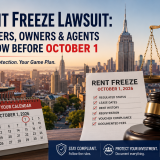
**NYC Real Estate Update | September 16, 2026**
After more than a year of legal uncertainty, New York City’s **Fairness in Apartment Rental Expenses Act**, commonly known as the **FARE Act**, has survived a major appellate challenge.
On July 13, 2026, the United States Court of Appeals for the Second Circuit affirmed the lower court’s judgment in *Real Estate Board of New York, Inc. v. City of New York*. The ruling leaves the FARE Act in effect and reinforces a straightforward operational message for New York City’s residential rental industry:
**Owners, property managers, and brokers should treat FARE Act compliance as an immediate and continuing responsibility.**
The complete ruling is available in the [Second Circuit’s July 13, 2026 opinion].
—
The FARE Act at a Glance
– **Official name:** Fairness in Apartment Rental Expenses Act
– **Law:** New York City Local Law 119 of 2024
– **Effective date:** June 11, 2025
– **Primary regulator:** NYC Department of Consumer and Worker Protection
– **Core rule:** A broker representing—or listing an apartment with the authorization of—a landlord may not charge the prospective tenant a broker fee.
– **Tenant choice remains protected:** A renter may voluntarily hire and pay an independent tenant’s broker.
– **Disclosure requirement:** Required tenant-paid fees must be clearly disclosed in the listing and in an itemized written disclosure before the lease is signed.
The complete legislation and legislative history are available through the [New York City Council’s Local Law 119 record].
—
A Simple FARE Act Fee Guide
Who retained the broker?
**The landlord hired or authorized the broker**
↓
**The broker may not charge the prospective tenant a fee**
**The tenant independently selected and hired a broker**
↓
**The tenant may agree to pay that broker**
**The tenant was told that hiring a particular broker was required to rent or view the apartment**
↓
**That condition may violate the FARE Act**
The guiding principle is simple: **A renter should not be forced to pay for a broker whose services the landlord selected or authorized.**
—
What the FARE Act Requires
1. Landlord-side brokers cannot charge prospective tenants
A landlord’s agent may not impose or collect a broker fee from a prospective tenant in connection with renting residential property.
This prohibition also applies to a broker who publishes a rental listing with the landlord’s permission or authorization. Under the law, there is a **rebuttable presumption** that a broker publishing a rental listing is doing so with the landlord’s permission.
2. A landlord cannot require a renter to hire a particular agent
The availability of an apartment cannot be conditioned on the prospective tenant retaining:
– A particular broker
– The landlord’s broker
– A listing agent
– A dual agent representing both sides of the transaction
A broker also should not require a renter to “hire” the broker merely to see, apply for, or rent a particular apartment.
3. Renters may still hire their own brokers
The FARE Act does **not** eliminate tenant representation.
A renter may independently retain a broker to help identify apartments, arrange showings, prepare an application, negotiate terms, or otherwise represent the renter’s interests. When that relationship is voluntary and genuinely tenant-directed, the renter may agree to pay the broker’s fee.
4. Required tenant fees must be disclosed
Every residential rental listing must clearly and conspicuously identify fees the prospective tenant will be required to pay.
Before the lease is signed, the landlord or landlord’s agent must also provide an **itemized written disclosure** that:
– Lists each required fee
– Briefly explains what each fee covers
– Is signed by the tenant before the lease is executed
– Is provided to the tenant as a copy
– Is retained by the landlord or landlord’s agent for three years
The FARE Act does not necessarily prohibit every lawful rental-related charge. Its disclosure provisions are intended to ensure that prospective tenants are informed about required fees before committing to a lease.
—
What the Real Estate Industry Challenged
An industry coalition led by the Real Estate Board of New York challenged the law shortly after its passage.
The principal arguments included claims that the FARE Act:
– Improperly restricted brokers’ commercial speech
– Unconstitutionally impaired existing brokerage agreements
– Was preempted by New York State law
The plaintiffs sought a preliminary injunction that would have stopped the City from enforcing the law while the litigation continued. The district court declined to issue that injunction, and the FARE Act went into effect on June 11, 2025.
—
Why the Second Circuit Rejected the Challenge
The commercial-speech claim
The appellate court agreed that part of the FARE Act regulates commercial speech. However, commercial speech does not receive the same level of constitutional protection as political or other noncommercial expression.
The court concluded that the challenged provision is **content-neutral** and survives the applicable intermediate-scrutiny test.
In reaching that conclusion, the court recognized several substantial public interests identified by the City:
– Aligning payment responsibility with the party that retains the broker
– Reducing the substantial upfront costs associated with moving
– Improving housing mobility
– Increasing fairness and transparency in the rental market
– Allowing renters to understand and negotiate fees more effectively
The court also determined that the law reasonably advances those interests without restricting more speech than necessary.
The Contracts Clause claim
The courts recognized that the law may substantially affect certain older tenant-pays brokerage agreements. Nevertheless, the appellate court concluded that the challengers had not demonstrated the required likelihood of ultimately succeeding on their Contracts Clause claim.
The court found that the City was pursuing a legitimate public purpose and that the FARE Act represented a reasonable method of addressing the identified housing-market concerns.
Accordingly, the Second Circuit affirmed the denial of a preliminary injunction.
The state-law preemption claim
The district court rejected the argument that the FARE Act improperly interfered with New York State’s regulation of real estate brokers. The plaintiffs did not pursue that issue on appeal.
—
What the Decision Does—and Does Not—Mean
The decision represents a significant legal victory for New York City and leaves the FARE Act fully operational.
For practical purposes:
– The FARE Act remains enforceable.
– The appellate court did not revive the request to block the law.
– Owners, managers, and brokers should not delay compliance in anticipation of another challenge.
– Further litigation or another attempted appeal may still be possible, but that possibility does not suspend the existing law.
There is also an important legal nuance: the Second Circuit affirmed the dismissal of the commercial-speech claims and the denial of preliminary relief on the Contracts Clause theory. It did not issue a blanket declaration that every possible future challenge to the law is permanently foreclosed.
That distinction matters to attorneys. For day-to-day real estate operations, however, the message is much simpler:
**The FARE Act is in force, and covered parties must comply.**
—
Compliance Checklist for Owners and Property Managers
Owners and managers should consider taking the following steps:
– **Audit existing brokerage agreements.** Confirm who retained the broker, whom the broker represents, and how the broker will be compensated.
– **Review every rental listing.** Remove language suggesting that a prospective tenant must pay the landlord’s or listing broker’s fee.
– **Examine co-brokerage arrangements.** Confirm that cooperating brokers understand which party they represent and who may lawfully be charged.
– **Standardize fee disclosures.** Use a written process for listing all required tenant-paid fees clearly and consistently.
– **Obtain the tenant’s signature.** The itemized fee disclosure should be signed before the lease is executed.
– **Preserve records.** Maintain the signed fee disclosure for the required three-year period and provide the tenant with a copy.
– **Monitor outside brokers.** Owners may be held responsible for prohibited fees charged by their agents or authorized listing brokers.
– **Train leasing personnel.** Everyone communicating with prospective tenants should understand the difference between a landlord’s agent and a voluntarily retained tenant’s agent.
– **Document compliance.** Keep records showing who authorized each listing, the broker’s agency relationship, the fees disclosed, and the documents delivered to the tenant.
—
Compliance Checklist for Brokers and Agents
Brokers should make agency and compensation relationships clear from the beginning of the transaction.
– **Identify whom you represent—in writing.**
– **Do not charge a tenant for a listing published with the landlord’s authorization.**
– **Do not require a renter to retain you to view or rent a particular apartment.**
– **Do not describe a landlord-authorized listing broker as the tenant’s broker merely to shift the fee.**
– **Review listing language before publication.**
– **Disclose all required tenant-paid fees clearly.**
– **Coordinate with owners and managers to ensure consistent compliance procedures.**
– **Preserve communications and documents supporting the agency relationship.**
A signed document alone may not resolve the issue if the surrounding facts indicate that the renter had no genuine choice. The actual relationship and conduct of the parties matter.
—
What Renters Should Know
The FARE Act gives prospective tenants several important protections:
– You generally cannot be charged the fee of a broker representing the landlord.
– A broker who published the apartment listing with the landlord’s permission generally cannot charge you a fee.
– You cannot be required to hire a particular broker as a condition of renting an apartment.
– You may voluntarily hire your own broker and agree to pay that broker.
– Required fees must be disclosed in the apartment listing.
– You must receive an itemized written fee disclosure before signing the lease.
– You may file a complaint if you believe a landlord or broker has violated the law.
– The law also provides a private right of action, meaning an individual may be able to bring a civil claim.
Renters should preserve relevant evidence, including:
– Screenshots of the listing
– Text messages and emails
– Broker agreements
– Fee disclosures
– Payment requests
– Receipts and bank records
– The broker’s name and contact information
Official guidance and complaint information are available from the [NYC Department of Consumer and Worker Protection’s FARE Act resource page].
—
Frequently Asked Questions
Does the FARE Act make every NYC apartment “no fee”?
**No.** A tenant may still voluntarily hire and pay an independent tenant’s broker. Other lawful rental-related charges may also exist, but required tenant-paid fees must be properly disclosed.
Can a listing broker simply ask the tenant to sign a tenant-broker agreement?
Not when that agreement is effectively required to access or rent the broker’s landlord-authorized listing. A broker should not use paperwork to relabel a landlord-side relationship when the renter did not independently select and retain the broker.
Is the landlord responsible if the broker violates the law?
Potentially, yes. NYC’s official guidance states that a landlord can be liable when the landlord’s agent—or an authorized listing agent—improperly charges a tenant.
Did the July 2026 court ruling create the FARE Act?
**No.** The law took effect on **June 11, 2025**. The appellate decision upheld the lower court’s treatment of the challenge and left the law in place.
Can the industry continue challenging the law?
Additional legal activity may be possible, but the present ruling provides no basis for ignoring or delaying compliance.
—
The Bottom Line
The FARE Act has now passed an important appellate test.
For renters, it strengthens the principle that people should not be forced to pay for a broker they did not choose. For owners, managers, and brokers, it requires greater attention to agency relationships, compensation agreements, rental advertising, fee disclosures, and recordkeeping.
The safest course is to assume that every listing, broker agreement, fee request, and pre-lease disclosure may eventually be reviewed by a regulator, tenant’s attorney, or court.
**Clarity is no longer merely good customer service—it is a compliance requirement.**
—
Author’s Note
This article provides a general educational summary of the FARE Act and the July 13, 2026 appellate decision. It is not comprehensive and does not constitute legal advice. Owners, property managers, brokers, agents, and tenants should consult qualified New York counsel regarding their particular circumstances.
**Sources last reviewed: September 16, 2026.**
—
For tailored guidance or to explore luxury homes in New York’s emerging markets, feel free to reach out to Sydney Harewood at NYC Exclusive Apartments (☎️ 646-535-3819, nycexclusiveapts.com “Your Premier Bridge to Manhattan Living and Wealth.”). With deep local expertise and a personalized approach, Sydney is ready to help you discover your own slice of the storybook lifestyle.
We hope you found this information helpful. If you have any other questions or need more details, feel free to contact us.